AnyS1 · Skill-Grounded Dual-System LLM Agents

Thinking Fast, Anywhere:
One System-1 for the Decision Points of Any Agent Workflow

AnyS1 Framework & Skill Compiler  ·  Any-DP Dataset (1,072 Skills · 25,986 Consensus States)  ·  Calibrated 4B System-1
TL;DR: Mine enumerable decision points from public SKILL.md files once, train a single calibrated 4B pointer System-1 on 26K container-executed states (Any-DP), and execute any skill-guided workflow as a fast–slow dual system—cutting episode cost by 75–91% and model-call time by 63–92% relative to an uncompiled System-2 agent, without sacrificing task success.
Read Full Paper Abstract

Autonomous LLM agents excel at long-horizon tasks, yet querying a large model (System-2) at every step incurs high latency and cost—even though a large fraction of intermediate steps are merely bounded choices among known options. Existing dual-system agents offload such judgments to a lightweight decision model (System-1), but rely on decision points manually pre-defined for a single fixed workflow; meanwhile, general agents increasingly load procedural skills on demand whose instructions implicitly specify where to judge and among which options. We propose AnyS1, which mines grounded enumerable decision points across over 1,000 public skills and executes synthesized tasks in isolated containers to collect Any-DP (26K consensus-labeled execution states), training a single 4B pointer model with label smoothing so one System-1 serves unseen workflows. At run time, compiled workflows delegate an enumerable decision to System-1 in one forward pass when its confidence clears a threshold calibrated on unlabeled development runs (AnyS1warm) or transferred zero-shot (AnyS1cold), falling back to System-2 otherwise. Across three unseen benchmarks (SOPBench, ALFWorld, and WebShop) paired with DeepSeek-V4.1-Flash or GPT-6 Sol as System-2, AnyS1 preserves all-System-2 success while reducing episode cost by 75–91% and model-call time by 63–92% relative to an uncompiled System-2 agent under AnyS1warm, and likewise maintains task reliability with zero target data under AnyS1cold.

64.5% E-Nodes
17,865 Mined Decision Points
Extracted across 1,072 public SkillMD-138K skills (16 categories); 100% of skills contain at least one enumerable judgment.
83.8% Dev Acc.
25,986 Consensus States (Any-DP)
Container-executed trajectories outperform LLM-written synthetic states by +18.8 pts and cross-task real states by +7.0 pts.
−75% to −91%
Episode Cost Reduction vs. Uncompiled Agent (AnyS1warm)
Saves 89% avg (DeepSeek-V4.1-Flash) and 82% avg (GPT-6 Sol) vs. 81% / 71% for the compiled All-S2; AnyS1cold saves 87% / 81% avg with zero target runs.
55–81× Faster
22–32 ms Single-Pass System-1
One forward pass on H100 (vs. 1.51–1.78 s for S2 and 0.65–0.67 s for 4-rotation Jev), cutting episode model time by 63–92% vs. the uncompiled agent.
01 · Motivation & Problem Formulation

From Per-Workflow Manual Hooks to Skill-Mined Dual-System Execution

Prior dual-system agents hard-code System-1 hooks for a single fixed workflow. Because general agents load procedural skills (SKILL.md) on demand—whose branches implicitly state where to judge and among which options—AnyS1 mines decision points across skills once to serve unseen workflows.
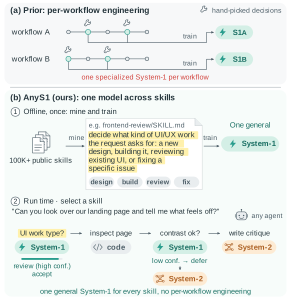
Figure 1: From per-workflow hooks to skill-mined dual-system execution
Figure 1 (🔍 Click to Zoom): (a) Prior dual-system agents engineer separate System-1 hooks per workflow. (b) AnyS1 mines enumerable decisions across public skills once offline to train one general System-1 for unseen workflows.
D · Deterministic (21.3%) 0 Tokens · Code

Steps fully determined by structured state—fixed tool calls, regex/file predicates, and state bookkeeping—execute directly as compiled Python code at zero token cost.

E · Enumerable (64.5%) 22–32 ms · AnyS1

Bounded choices over candidate sets $(q, O, d)$ fixed in the skill or enumerable from runtime state $s$: scored in a single forward pass by our calibrated 4B System-1 and gated against $\tau$ (100% of mined skills contain $\ge 1$ E-node).

G · Generative (14.2%) System-2 LLM

Open-ended synthesis, free-form code writing, search query formulation, and low-confidence fallbacks ($c(x) < \tau$) are reserved for the frontier System-2 model.
The Cost Ceiling Law (Equation 1)

Why Enumerable Cost Share ($s_E$) Governs Maximum Savings

Splitting per-episode cost $C$ relative to an All-S2 baseline $C^{\mathrm{S2}}$ into System-2 generative turns ($C_G$), System-2 enumerable turns ($C_E$), and System-1 overhead ($\kappa$) reveals a structural ceiling: if trajectories stay unchanged, delegation can save at most $s_E - \kappa$. Savings can exceed it only when delegation also shortens later turns, as on SOPBench (35% saved at $s_E = 28\%$).

$$\frac{C}{C^{\mathrm{S2}}} \;=\; \underbrace{\frac{C_G}{C^{\mathrm{S2}}}}_{\approx\,1-s_E\text{ (untouched)}} \;+\; \underbrace{\frac{C_E}{C^{\mathrm{S2}}}}_{\le\, s_E\text{ (delegable)}} \;+\; \underbrace{\frac{C_{\mathrm{S1}}}{C^{\mathrm{S2}}}}_{\kappa\text{ (S1 overhead)}}$$
All-S2 Enumerable Share ($s_E$) & AnyS1 Cost / Time vs. Uncompiled Agent
WebShop ($s_E = 94\%$) 86% sav warm · 89% sav cold · 0.12× time
ALFWorld ($s_E = 90\%$) 88% sav warm · 85% sav cold · 0.08× time
SOPBench ($s_E = 28\%$) 91% sav warm · 87% sav cold · 0.30× time
Compound Gain over Uncompiled Agents: Compiled All-S2 saves 76–86% of the uncompiled agent's cost (+18 avg pts); AnyS1warm raises the saving to 86–91% (DeepSeek-V4.1-Flash).
02 · AnyS1 Framework Overview

Single-Source Self-Execution Pipeline: From Public Skills to AnyS1

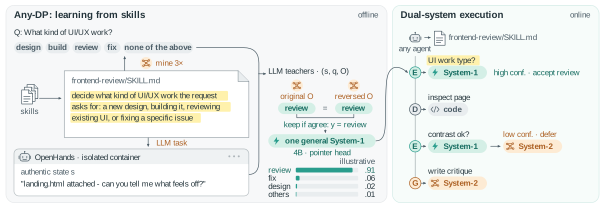
AnyS1 requires zero human annotations or third-party trajectory logs. Every decision point, executed trajectory state, and deferral threshold is derived from public SKILL.md repositories.

Figure 2: Overview of the four-stage AnyS1 pipeline
Figure 2 (Click to Zoom): Four-stage AnyS1 pipeline. Stage 1 (§3.2): Extract grounded D/E/G decision points across 1,072 public skills via $3\times$ independent passes and self-consistent merging ($\sigma(p)\ge 2$). Stage 2 (§3.2): Synthesize verifier-checked multi-stage container tasks with distractor skills, roll out OpenHands trajectories, and retain verbatim states with forward/reverse teacher consensus (Any-DP, 25,986 states). Stage 3 (§3.3): Train a 4B pointer model with permutation-equivariant OptionInteractionHead and label smoothing ($\epsilon=0.1$). Stage 4 (§3.3): Gate each runtime E-decision in one forward pass ($c(x)\ge\tau$) under AnyS1warm or zero-shot AnyS1cold.
Stage 1 · §3.2

Extracting Decision Points

Three independent LLM passes extract D/E/G decision points anchored to verbatim substring quotes from SKILL.md. Self-consistent merging retains E points with support $\sigma(p)\ge 2$ and writes a 1-sentence definition $d(o)$ per option.

Stage 2 · §3.2

Task & State Synthesis

Each skill is turned into verifier-validated multi-stage container tasks with 2 distractor skills. OpenHands executes verified tasks in isolated containers ($T=0, 0.7$); verbatim observation states are labeled by forward/reverse teacher consensus ($y^1 = y^2$).

Stage 3 · §3.3

Architecture & Calibration

Built on Qwen3.5-4B-Base with rank-16 LoRA, a pointer scoring head with permutation-equivariant OptionInteractionHead (oc), and label smoothing ($\epsilon=0.1$) to prevent overconfidence on unseen skills.

Stage 4 · §3.3

Calibrated Deferral Gate

Accepts System-1 in one forward pass when $c(x) = \max_o p_f(o\mid x) \ge \tau$ (chosen for $\ge 95\%$ agreement). Cold-start AnyS1cold transfers $\tau=0.918$ zero-shot; AnyS1warm fits $\tau$ on 50 unlabeled development runs.

03 · Interactive Skill Compiler Playground

From a SKILL.md to a Dual-System Workflow

A skill already says where the agent must choose and which options apply. The compiler marks each step as D (run as code), E (an enumerable choice that System-1 answers first), or G (open generation left to System-2). Pick an example or edit the source; hover any step to see where it lands.

SKILL.md
input
Compiled workflow
one node per step, in execution order
τcold = 0.918
    Generated files decisions.json · SKILL.anys1.md · workflow.py


    This preview runs the offline structural parser in your browser (anys1 compile SKILL.md --offline). The full compiler (anys1 compile) extracts decision points with three grounded System-2 passes and merges them.

    04 · Interactive Dataset Inspector

    Explore Any-DP: From Verbatim Skill Quotes to Executed Container States

    Skills state what to decide, but not the runtime observations in which those decisions arise. Inspect real records from Any-DP below to see how each mined decision point is instantiated via a verifier-checked multi-stage container task, captured as a verbatim trajectory state, and scored by our calibrated 4B System-1.

    05 · Calibrated System-1 & Selective Deferral

    Single-Pass Calibrated Deferral & Cross-Backbone Cost Simulator

    A gate that accepts System-1's answer when its probability is high enough requires probabilities that reflect how likely the answer is to be right—even on skills and states the model has not seen. We bake calibration into training via label smoothing ($\epsilon = 0.1$) and evaluate both unlabeled development-run and zero-target-run gates across two frontier System-2 backbones.

    Single-Pass Scoring & Threshold Calibration

    1 Forward Pass · 22–32 ms

    System-1 concatenates $(s, q, O, d(O))$ and scores all options in a single forward pass with a pointer head enhanced by a 1-layer no-position self-attention block (OptionInteractionHead, $d_p=256$):

    $$\mathcal{L} = \sum_{(x,y)\in\mathcal{D}} \mathrm{CE}\big(p_f(\cdot\mid x),\,(1-\epsilon)e_y + \epsilon u_O\big), \quad g(x) = \mathbb{I}\big[\max_{o\in O} p_f(o\mid x) \ge \tau\big]$$
    • AnyS1warm (Unlabeled Dev-Run Calibration): Fits $\tau$ on 50 unlabeled development episodes where System-2 answers and System-1 only scores (0 human labels; $\tau = 0.61$ on SOPBench, $0.89$ on ALFWorld, $0.95$ on WebShop).
    • AnyS1cold (Zero-Shot Transferred Threshold): Transfers a single $\tau = 0.918$ fitted on the 153 dev-split examples (uses zero target-workflow runs).
    Interactive Gate & Calibration Diagnostic

    Cost & Gate Simulator

    Pick a System-2 backbone and a configuration to compare episode cost (split into S2 G-nodes, deferred S2 E-nodes, and System-1 overhead) and task success against All-S2:

    S2 at G-Nodes (Reasoning/Gen) S2 at E-Nodes (Deferred) System-1 Overhead
    06 · Worked Example

    One ALFWorld Episode Through AnyS1

    A single episode covers every node type: System-2 handles open-ended generation, System-1 answers confident enumerable judgments in one forward pass, uncertain search is deferred back to System-2, and deterministic steps run as code.

    Goal: “Put a clean mug in the coffee machine.”
    G System-2 generation E enumerable judgment (gated) D deterministic code
    1G
    Parse the household goalG · System-2
    Task: Put a clean mug in the coffeemachine. Visible: countertop 1, cabinet 1–4, fridge 1, microwave 1, sinkbasin 1, coffeemachine 1.
    System-2 decomposes the goal: object = mug, must be clean (wash at sinkbasin 1), destination = coffeemachine 1.
    Open-ended generation (G-node) always stays with System-2.
    2E
    Where should we search first?E · deferred → S2
    Unvisited receptacles: countertop 1, cabinet 1–4, shelf 1, drawer 1, fridge 1, garbagecan 1 (9 options + none).
    System-1 confidence $c(x)=0.41 < \tau=0.89$ → deferred; System-2 picks countertop 1.
    In an unseen room several receptacles are plausible, so confidence stays low. Without the gate (All-S1), ALFWorld success drops from 96.3% to 40.3%, and 71 of 77 losses diverge at a search node.
    3E
    Is the target object visible?E · accepted by S1 (24 ms)
    go to countertop 1 → You see a butterknife 1, a mug 2, a peppermill 1, and a toaster 1.
    System-1 answers yes — mug 2 is present with $c(x)=0.96 \ge \tau$ in one 24 ms forward pass.
    Replaces a 1.51 s System-2 call; AnyS1warm delegates 96% of such visible-object checks at 99.5% agreement with System-2.
    4D
    Pick up, go to the sink, cleanD · deterministic code
    Bound: target_item = mug 2, modifier = clean (false).
    Runs take mug 2 → go to sinkbasin 1 → clean mug 2 as compiled code.
    0 LLM tokens, 0 model latency.
    5E
    Is the precondition satisfied?E · accepted by S1 (24 ms)
    You clean the mug 2 using the sinkbasin 1. Inventory: mug 2 (clean).
    System-1 answers yes — proceed to placement ($c(x)=0.97$); the mug is placed and the episode succeeds.
    Same outcome as All-S2.
    Benchmark-level effect (ALFWorld, DeepSeek-V4.1-Flash, AnyS1warm): 51% of E-decisions delegated, episode cost reduced by 88% vs. the uncompiled agent (0.12×; All-S2: 0.19×) and model time from 163 s (uncompiled) and 21.3 s (All-S2) to 12.9 s, success 95.5% vs. 96.3% (1 game lost).
    07 · Empirical Evaluation (RQ1 – RQ4)

    Online Dual-System Results, Scaling & Gate Ablation, Latency, and Decision Analysis

    All dual-system configurations use our 4B System-1 trained exclusively on Any-DP (1,072 skills, 25,986 states) and are paired with All-S2 via a shared request cache so that runs differ strictly where System-1 answers.

    Configuration SOP Pass SOP Sav. % SOP Time (s) ALF SR ALF Sav. % ALF Time (s) WS Score WS SR WS Sav. % WS Time (s) Avg Δ pt Avg Sav. %
    System-2: DeepSeek-V4.1-Flash (Single-System Agent, Compiled Reference, and Dual-System AnyS1)
    System-2 Agent with Skills (Uncompiled) 55.2 — 51.4 82.8 — 163 54.9 34.4 — 146 −17.8 —
    Compiled Workflow (All-S2) 83.2 86% 25.0 96.3 81% 21.3 66.9 38.0 76% 29.0 — 81%
    Jev as System-1† (jev-1.14.0 API) 84.0 87% 23.9 96.3 84% 20.5 67.1 38.6 83% 17.3 +0.3 84%
    AnyS1warm (50 unlabeled dev runs) 84.3 91% 15.6 95.5 88% 12.9 68.1* 38.8 86% 17.1 +0.5 89%
    AnyS1cold (transferred $\tau=0.918$, 0 runs) 83.2 87% 21.2 95.5 85% 15.7 67.9 38.0 89% 12.7 +0.1 87%
    System-2: GPT-6 Sol (Same 4B System-1 Trained Only on Any-DP, Paired with a Stronger Unseen System-2)
    System-2 Agent with Skills (Uncompiled) 61.2 — 207.6 88.8 — 413.5 48.5 33.6 — 317.3 −16.8 —
    Compiled Workflow (All-S2) 82.1 86% 124 96.3 56% 193 70.6 41.8 72% 81.4 — 71%
    AnyS1warm (50 Sol dev episodes) 82.5 91% 75.8 95.5 75% 101 70.4 40.0 80% 49.4 −0.2 82%
    AnyS1cold (unchanged transferred $\tau=0.918$) 82.5 88% 107 94.0 69% 134 70.1 40.4 86% 33.3 −0.8 81%

    Note: $^*$ indicates that the 95% paired bootstrap CI of the difference from All-S2 excludes 0. Sav. % reports episode cost savings (%) relative to the uncompiled System-2 Agent with Skills (System-2 + System-1, with self-hosted 4B System-1 priced at L4 GPU serving cost $0.0045/1k decisions and Jev at $0.042/1M input tokens; uncompiled rows are the reference, —). Time (s) reports critical-path model-call seconds per episode. Under both DeepSeek-V4.1-Flash and GPT-6 Sol, AnyS1warm preserves success (raising WebShop score by +1.3* CI under Flash) while reducing episode cost by 75–91% (mean 89% / 82%, vs. 81% / 71% for All-S2) and model-call time by 63–92% relative to the uncompiled agent.

    RQ2 · Executed vs. Third-Party States

    Self-Executed Any-DP Beats Cross-Task Real Training (+7.0 Pts)

    On held-out public container Dev states, our 4B System-1 trained solely on Any-DP reaches 83.8% accuracy (3-seed mean), beating the same model trained on 6,118 cross-task real trajectory states (76.8%, +7.0) and LLM-written synthetic states (65.0%, +18.8), while reaching 93.5% vs. 89.8% on SOPBench E-decisions.

    RQ2 · Why Label Smoothing Matters

    Label Smoothing ($\epsilon=0.1$) Keeps Confidence Transferable

    Without label smoothing, plain cross-entropy keeps accuracy unchanged (82.3% vs. 82.4%) but puts probability $\ge 0.90$ on 88–93% of decisions instead of 44–76%. The dev threshold $\tau$ jumps from 0.904 to 0.998 and fails on ALFWorld: delegating 70% of E-decisions at only 83.0% agreement, versus 98.4% agreement with label smoothing.

    RQ2 · Why the Gate Matters

    Without Deferral (All-S1), ALFWorld Collapses to 40.3%

    When System-1 answers every E decision without a gate (All-S1), SOPBench is $+1.1$ at $0.63\times$ and WebShop is $-0.5$ score points at $0.10\times$, but ALFWorld collapses from 96.3% to 40.3% (75 games lost, 0 won; 71/77 losses diverge at a search node). Either AnyS1warm or AnyS1cold loses only 1 game (95.5%).

    Decision-Level Model (3 Seeds Each) Dev (Held-Out) SOP E (%) ALF E (%) ALF Search (%)
    Zero-Shot & Commercial Baselines
    Kev-4B (Zero-Shot)57.888.756.916.3
    AgentDecision-4B74.688.269.540.4
    Qwen3.5-4B (Zero-Shot)71.491.770.944.0
    Qwen3.5-27B (Zero-Shot)85.993.877.256.8
    Jev (Commercial API)78.495.581.266.4
    Fine-Tuned on Alternative Supervision (4B-Base)
    LLM-Written Synthetic (S1-syn)65.091.763.628.6
    Cross-Task Real States Only (6,118 states)76.889.869.642.5
    Fine-Tuned on Any-DP (Ours · Self-Executed States Only)
    Any-DP · 25% of Skills (268 skills)80.792.169.740.7
    Any-DP · 50% of Skills (537 skills)84.793.068.337.6
    Any-DP · 100%, Standard Pointer Head82.793.768.037.8
    Any-DP · 100%, Option-Interaction Head (AnyS1 S1) 83.8 93.5 68.9 41.5
    Gate & Calibration Ablation SOPBench Pass / Cost vs. Uncompiled ALFWorld SR / Cost WebShop Sc. / Cost
    Online Deferral Gate Ablation (Same 4B System-1)
    All-S2 (0% delegated) 83.2% / 0.14× 96.3% / 0.19× 66.9 / 0.24×
    All-S1 (No gate · 100% delegated) 84.3% (+1.1) / 0.09× 40.3% (-56.0*) / 0.04× 66.3 (-0.5) / 0.02×
    AnyS1cold (Transferred $\tau=0.918$) 83.2% (0.0) / 0.13× 95.5% (-0.7) / 0.15× 67.9 (+1.0) / 0.11×
    AnyS1warm (50 S2 dev runs) 84.3% (+1.1) / 0.09× 95.5% (-0.7) / 0.12× 68.1 (+1.3*) / 0.14×
    Offline Calibration Objective Study (Transfer to SOPBench & ALFWorld)
    Label Smoothing ($\epsilon=0.1$, Ours) ECE 0.094 · $\tau=0.904$ SOP: 67% del / 98.4% agr ALF: 42% del / 98.4% agr
    Plain Cross-Entropy ($\epsilon=0$) ECE 0.146 · $\tau=0.998$ SOP: 81% del / 98.5% agr ALF: 70% del / 83.0% agr
    Cross-Entropy + Brier Loss ECE 0.148 · $\tau=0.996$ SOP: 83% del / 97.8% agr ALF: 67% del / 86.7% agr
    Takeaway: Both ingredients are essential: (1) without a gate (All-S1), open-world ALFWorld search decisions collapse success from 96.3% to 40.3%; (2) without label smoothing ($\epsilon=0.1$), probability saturation ($\tau \to 0.998$) causes transferred thresholds to fail on ALFWorld (83.0% vs. 98.4% agreement).
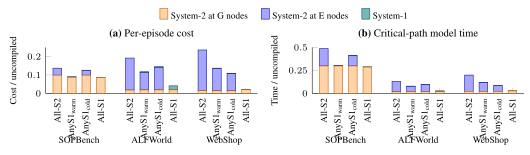
    Figure 3: Per-episode cost and model time relative to the uncompiled System-2 agent, decomposed into G-nodes, E-nodes, and System-1 overhead
    Figure 3 (Click to Zoom): (a) Per-episode cost and (b) critical-path model time relative to the uncompiled System-2 agent with skills, split into System-2 at G-nodes, System-2 at E-nodes, and System-1 inference overhead across SOPBench, ALFWorld, and WebShop (Equation 1 decomposition).

    Table 4 · Per-Decision & Episode Critical-Path Latency

    55–81× Faster Decisions

    System-1 latency is measured at batch size 1 on a single H100 GPU (bf16) over logged development E-states; System-2 and Jev latencies come from the online evaluation logs:

    Latency Metric SOPBench ALFWorld WebShop
    Seconds per Decision (Median, Batch Size 1)
    System-2 (LLM E-Node Call) 1.78 s 1.51 s 1.77 s
    Jev API (4 Rotations) — 0.65 s 0.67 s
    System-1 (AnyS1 · 1 Forward Pass) 0.022 s (22 ms) 0.024 s (24 ms) 0.032 s (32 ms)
    Critical-Path Model-Call Time per Episode
    System-2 Agent with Skills (Uncompiled Reference) 51.4 s (1.00×) 163 s (1.00×) 146 s (1.00×)
    All-S2 (Compiled Workflow) 25.0 s (0.49×) 21.3 s (0.13×) 29.0 s (0.20×)
    AnyS1warm (Single-Pass Calibrated Gate) 15.6 s (0.30×) 12.9 s (0.08×) 17.1 s (0.12×)

    Where the Savings Come From: E-Share Ceiling & S1 Overhead

    Equation 1 Decomposition

    Savings below are relative to the uncompiled System-2 agent; what delegation can still remove after compilation follows $s_E$ (the fraction of All-S2 cost spent on E-nodes):

    • WebShop ($s_E = 94\%$): System-2 does little besides answer E-nodes. Delegating 44% of E-decisions under AnyS1warm cuts cost by 86% (0.14×; All-S2: 0.24×) and critical-path model time from 146 s → 17.1 s (0.12×); AnyS1cold delegates 58% to cut cost by 89% (0.11×).
    • ALFWorld ($s_E = 90\%$): AnyS1warm delegates 51% of E-decisions (deferring room search nodes), cutting cost by 88% (0.12×; All-S2: 0.19×) and model-call time from 163 s → 12.9 s (0.08×).
    • SOPBench ($s_E = 28\%$): Reasoning G-nodes (multi-turn dialogue and tool argument generation) account for 72% of All-S2 cost. AnyS1warm delegates 99% of E-nodes to cut cost by 91% (0.09× cost, 0.30× time; All-S2: 0.14× / 0.49×), slightly aided by shorter turns on delegated runs.
    • Negligible System-1 Overhead: Under L4 serving ($0.0045/1k decisions), System-1 adds $\kappa \le 2.1\%$ of All-S2 cost ($\le 0.4\%$ of the uncompiled agent's) and only 22–32 ms per call (55–81× faster than System-2).

    Table 5 · RQ4: Online Delegation & Agreement by Decision Kind

    AnyS1warm Breakdown
    Bench Decision Kind Share Delegated Agree w/ S2 Episodes Lost / Won
    SOPIntent (12–22 options)31%99%97.7%0 / 1
    SOPSlot value ($\le 7$ options)21%100%99.5%0 / 1
    SOPFollow-up role48%98%90.4%1 / 2
    ALFVisible object check35%96%99.5%1 / 0
    ALFReceptacle closed?9%90%94.4%0 / 0
    ALFSearch (where to look)43%17%58.6%0 / 0
    ALFReceptacle type13%16%78.3%0 / 0
    WebRelevance / match (yes/no)34%83%87.3%6 / 10
    WebDescription match (yes/no)7%13%72.7%0 / 1
    WebOption checks26%57%94.0%2 / 1
    WebOption value15%0%—0 / 0
    WebProduct choice ($>7$ options)19%0%—0 / 0

    Key Insights: (1) Observation checks transfer across domains (90–100% delegated at 90–100% agreement), whereas open-world search and multi-item ranking have lower confidence and are deferred to System-2. (2) Under AnyS1warm, 166 of 500 WebShop episodes diverge from All-S2, yet task success changes in only 20 episodes (12 won, 8 lost).

    Table 1 & Table 6 · Synthesized Dataset Any-DP & Quality Audit

    1,072 Skills · 16 Categories
    Skills Processed (SkillMD-138K)1,072
    Skill Categories16
    Extracted Decision Points (D / E / G)17,865 (21.3% D · 64.5% E · 14.2% G)
      └ Enumerable Decision Points (E)11,523 (100% of skills have $\ge 1$ E-point)
    Synthesized Multi-Stage Tasks2,846 (verifier-validated + 2 distractor skills)
    Consensus-Labeled States ($|\mathcal{D}|$)25,986 (median 21 states/skill; 89.2% teacher agreement)
    Options per Decision PointMedian 3; 94.5% have $2\text{--}7$ options (6.7% pick none)
    Cross-Family Blind Audit (500 States)98.0% label correct (99.8% defensible); 97.4% D/E/G type correct
    08 · Quickstart & Citation

    Get Started


    BibTeX Citation
    @misc{li2026anys1,
      title         = {Thinking Fast, Anywhere: One System-1 for the Decision Points of Any Agent Workflow},
      author        = {Rui Li and Liyang He and Zheng Zhang and Zhenya Huang and Qi Liu},
      year          = {2026},
      eprint        = {2611.23751},
      archivePrefix = {arXiv},
      primaryClass  = {cs.CL},
      url           = {https://arxiv.org/abs/2611.23751}
    }